Parachute
Instant auto-CMS for the database you already own
A single binary that reads any database schema and generates a working CMS — tables, rows, relationships, and field-type inference included, no migrations required.
- Docker container
- Kubernetes Helm chart
- 7 database engines
- 5 object-store backends
- 3 auth methods
- 1 cache engine
- 1 languages (EN)
- REST API + OpenAPI 3.0.3
- Realtime WebSocket channels
- Atlas schema migrations
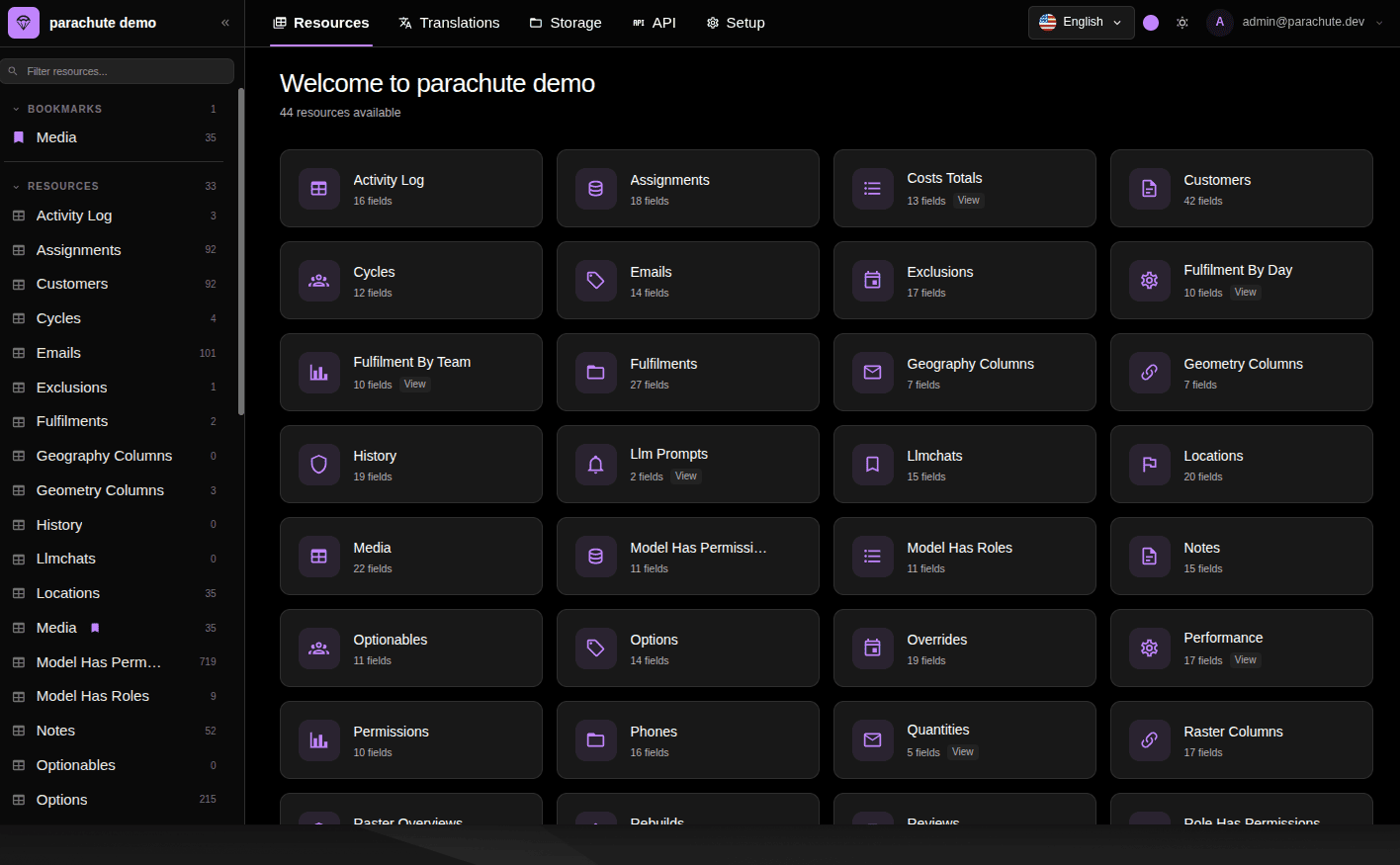
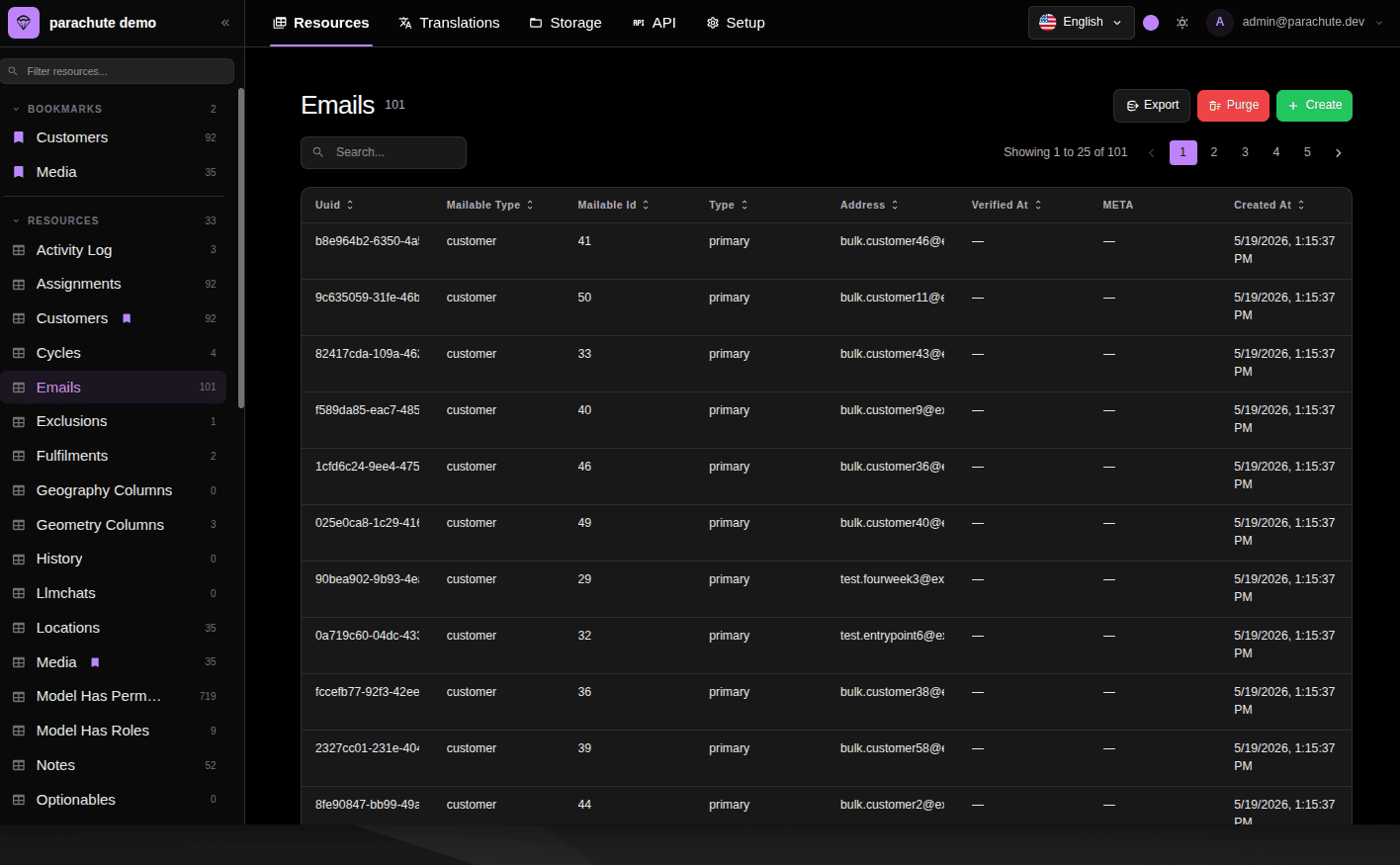
Parachute doesn't replace your framework — it sits alongside and reads the same database. Point it at Postgres, MySQL, SQLite, MongoDB, or 6 other engines, and get an instant admin UI. Every table browsable, every row editable, relationships linked, field types inferred. YAML-driven customisation. 32 field types, RBAC with 8 permissions, ECharts dashboards, filters, bulk actions, and metrics. One binary, zero friction.
Key features
Introspects 7 database engines: Postgres, MySQL, SQLite, MongoDB, Redis, Elasticsearch, ChromaDB
32 field types: text, rich text (TipTap/Quill), code editor, images, files, belongs-to, has-many, GeoJSON, vectors, JSON
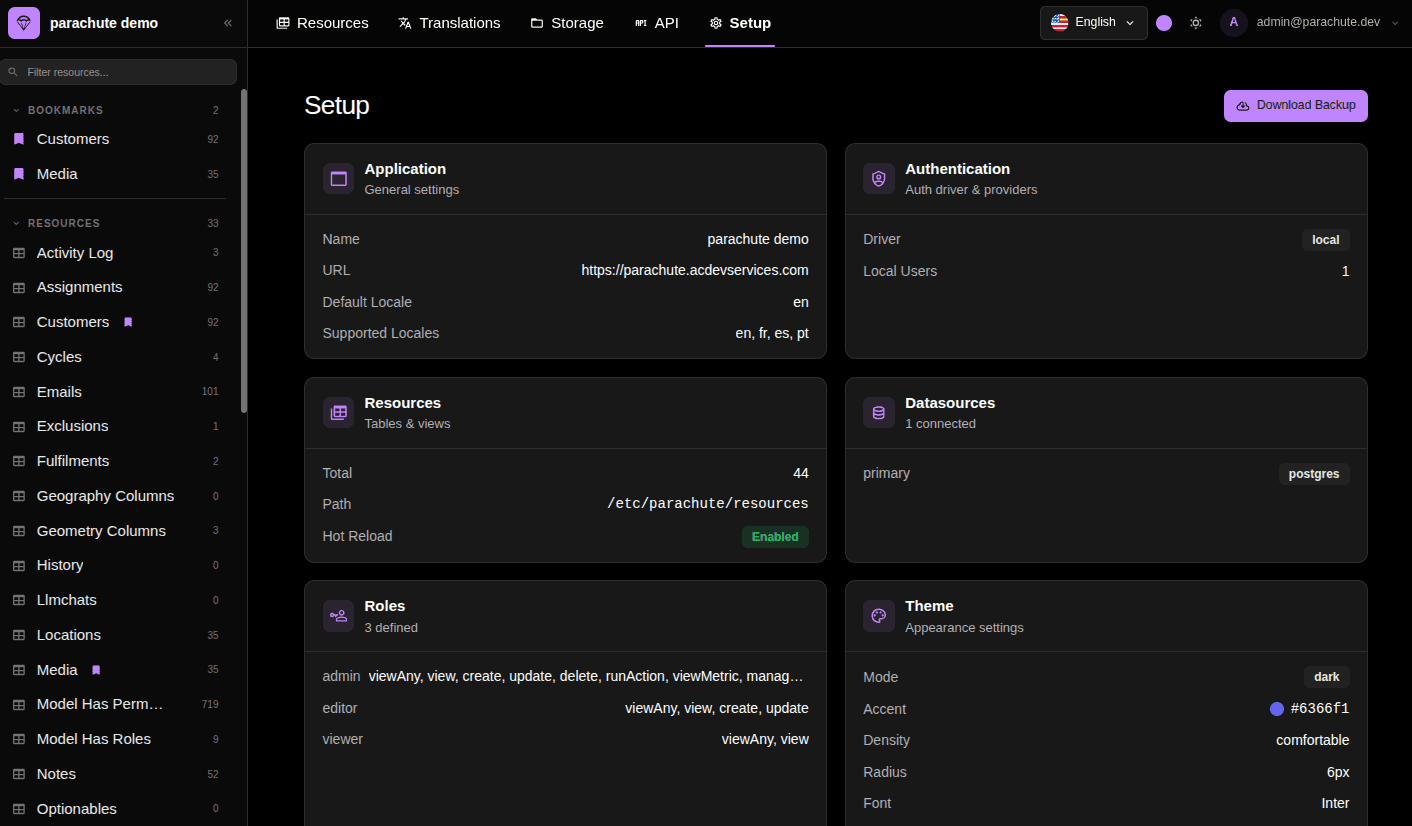
RBAC with 8 granular permissions (view, create, edit, delete, filters, actions, metrics, exports)
Hot-reload YAML editing of resource definitions — no restart
Custom dashboards with ECharts widgets (bar, line, area, pie, donut)
Translation editor with 13 format parsers (Laravel, Gettext, Android XML, iOS Strings, more)
File storage: local and S3-compatible
CMS auto-detection: WordPress, Laravel, Django, Drupal
OpenAPI 3.0.3 auto-generation
Theming: light/dark, accent colours, custom fonts, density, radius
Where it goes beyond the obvious
Single binary that reads any schema and generates a working CMS
32 field types covering nearly every common column type
Hot-reload YAML for instant resource changes without restarting
CMS auto-detection with optimisations for WordPress, Laravel, Django
Translation editor supporting 13 i18n format parsers
Tech highlights
- Engines: Postgres, MySQL, SQLite, MongoDB, Redis, Elasticsearch, ChromaDB
- Field types: 32 including rich text, code, relationships, spatial, vectors
- Auth: local (bcrypt+JWT), OAuth2/OIDC, LDAP/AD, mixed
- Dashboards: ECharts widgets
- Storage: local and S3
Built on
REST API surface
- GET /health, /ready — Kubernetes probes
- POST /auth/login JWT session
- GET /auth/oauth2/{provider} OAuth2 handshake
- GET /resources/{resource}/records CRUD with filters + sort
- POST /resources/{resource}/actions Bulk actions
- GET /resources/{resource}/export?format=json|csv Export
- GET /search?q= Global full-text search
- GET /apidocs/openapi.json Auto-generated OpenAPI
Full spec at GET /openapi — Swagger UI at /swagger/
Backends you can actually pick from.
This service speaks the backends below natively. Swap with a single environment variable.
Databases
- PostgreSQL
- MySQL
- SQLite
- MongoDB
- Redis
- Elasticsearch
- ChromaDB
Cache
- Redis
Object storage
- Local
- S3
- MinIO
- R2
- DigitalOcean Spaces
Auth
- Local bcrypt
- OAuth2/OIDC
- LDAP/AD
Realtime
- Centrifuge
Use cases
Auto-CMS for existing databases — legacy Postgres, inherited MySQL, a new Mongo
WordPress / Laravel admin extensions that go beyond the built-in panel
Internal tools for ops teams who need to browse and edit data
Rapid prototyping with browsable persisted state
Consultants auditing client databases without setup
Parachute vs Retool, Forest Admin, Directus
An instant CMS for the database you've been handed
Architecture patterns featuring this service
Ship an internal platform without building plumbing
Hand your team a production-grade platform on day one: object storage, queues, auth, observability — all self-hosted, all wired to the same contract.
Give ops and QA safe database access
Truffle for SQL, Stash for Redis, Depot for object storage — browser-based access with action-level permissions.
Deploy Parachute. Today.
One Docker image. One compose stack. One afternoon to production. Parachute is waiting.